
Construction Site Gate Control: What AI Adds to Cameras
Can your gate log tell you what that truck was carrying, how long it stayed, or whether the invoice was right? Let's explore how AI can.
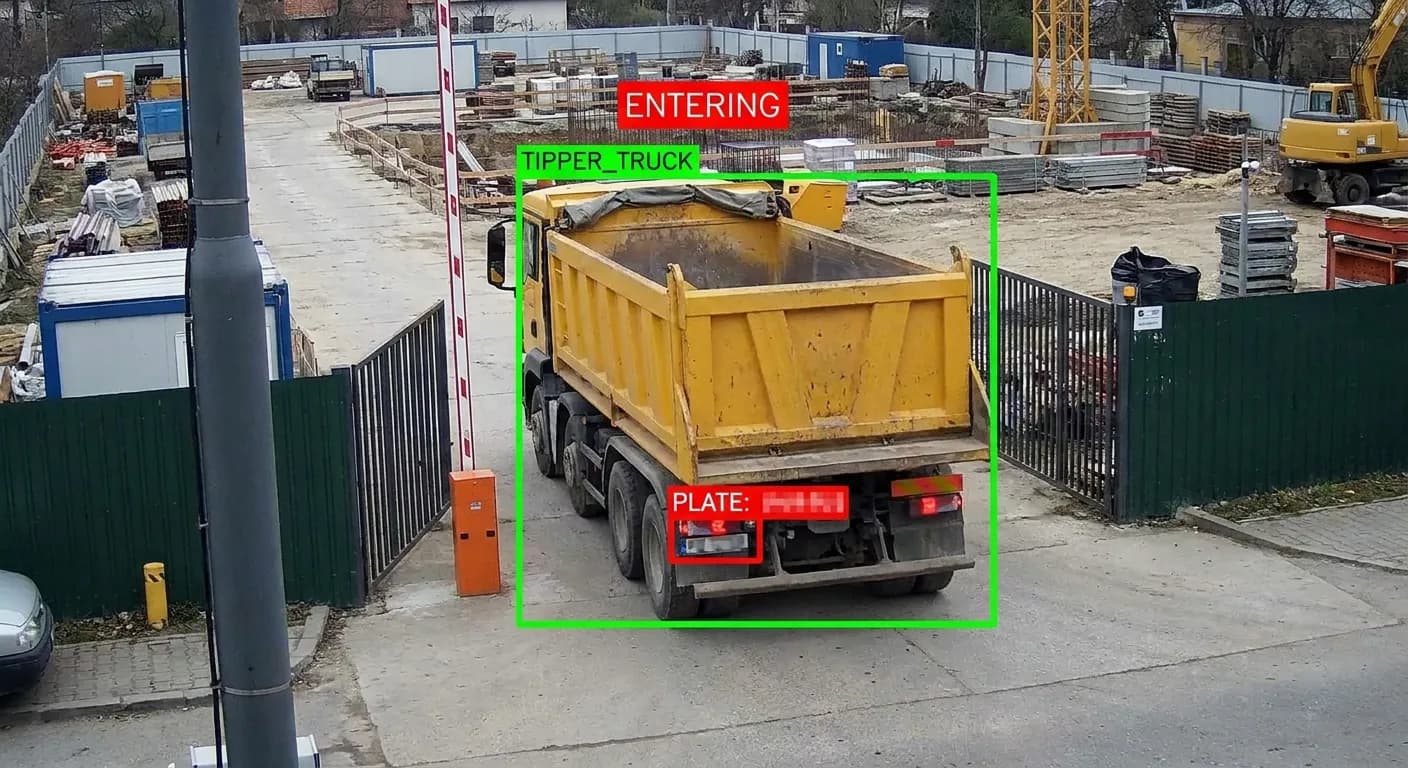
Your gates have cameras, so everything coming and going is recorded, and when something goes missing somebody can sit down and scrub through the footage until they find it. What you own is hours of video that nobody watches, in which nothing is counted and nothing adds up.
If the gate also has ANPR you are a step further on, since every vehicle leaves a row in a log with a registration and a timestamp against it. That is a real improvement and it is still a security record, while the money on a construction site turns on what those vehicles were, what they carried, how long they stayed and whether the invoices raised against them describe what happened. Those are operational questions, and answering them is what AI behind the camera is for.
What ANPR does well, and where it stops
Plate recognition answers one question reliably: which registration passed the gate, and when.
It also works less well here than the brochure suggests. The published accuracy figures, typically 90 to 98%, come from car parks: one approach lane, clean plates, a barrier that stops every vehicle. An engineer who spent years inside one of the large traffic enforcement vendors has pointed out that a system advertised at 99.9% often means 99.9% of the plates it judged readable in the first place.
The bigger problem is what happens on the reads that fail. An ANPR-only system produces nothing at all when a plate does not read: no error, no flag, no row marked as an unidentified vehicle. The log looks complete because it holds no concept of a vehicle it never identified, and the reads that fail are the filthy, heavily used trucks carrying the material you are paying for rather than the courier van that turns up once a week.
What computer vision adds
Vision runs alongside the plate reader and captures what a registration cannot describe. A camera that classifies the vehicle, judges whether it is carrying anything, and tracks it from entry through to exit turns a list of registrations into a record of what physically moved through your gate.
What kind of vehicle was it?
Classification is the first layer and the cheapest to add. A tipper, a mixer, a flatbed, a van and a tracked machine on a low-loader are visually distinct at distances and angles where the plate has already failed. Once the log records vehicle type alongside registration, your count of material leaving site stops depending on tickets, because you know how many tippers went out whether or not each one was identified.
Was it loaded or empty?
Load state is the layer that changes what the gate is for. A tipper leaving with a full body when the programme says it should be empty is worth a phone call, and a skip arriving full on a collection you are being charged for is worth a credit note. This is a harder problem than classification, since it depends on camera height, standoff distance and body geometry.
How long was it on site?
Dwell time is entry and exit joined into a single journey, which is the point at which standing charges and hire dates become checkable. When the exit plate fails to read, a classified vehicle with a matching visual signature can still close the journey.
What arrived with no plate at all?
A significant share of what enters a construction site carries no registration to read. Tracked plant arrives on the back of something else and is unloaded inside the hoarding. Subcontractors walk in through the pedestrian gate. Materials are dropped at the kerb and carried the rest of the way. An ANPR system is blind to all of this by design, so the hours when your gate is busiest with people and plant are the hours it describes least well.
The operational value behind construction gates
A gate log is a financial record that most sites use as a security record. Every timestamp on it attaches to something billable: a load removed, a truck waiting, a machine on hire.
In almost every dispute over a construction invoice, the party with the better record wins, because both sides put what they have on the table and the more complete set sets the terms of the settlement.
Delivery orders and materials
Ready-mix arrives by the truck and is invoiced against the supplier's tickets. Your gate knows how many mixers came through. Nobody joins those two numbers up, and whatever is between them is margin for whoever is doing the counting.
Run the arithmetic on your own site. Say you are taking 10 mixer loads a week across a 14-month programme, and say 1% of ticketed loads never arrived. That is around 6 loads you paid for and did not receive. Multiply by whatever a load of concrete costs you locally (substitute your own).
The same logic runs on anything else that arrives or leaves by the load, from aggregate to skips to excavated material.
Rented machines, billed by the day.
Hire runs from delivery to collection, so when a machine sits for eleven days before anyone comes to collect it the dispute is about a date, and a gate timestamp answers it.
The larger number is the one nobody argues about. A machine that turns up a fortnight before the works front is ready, or stays three weeks after its task finished because nobody raised a collection, is billed at full rate for every one of those days.
Four questions your gate records should settle
Try answering these from the records you already keep, then put the same five to anyone quoting to replace them.
1. How many mixers came through on a given day?
A count, by vehicle type, on a given day. If the only route to an answer is reading registrations one at a time and working out what each vehicle was, you have a list of identities rather than a set of counts, and nothing you can set against a delivery ticket.
2. Which machines are on site right now, and since when?
This needs entries matched to exits. If the answer comes from someone walking the site rather than from the log, hire duration and idle time cannot be measured, and every conversation about plant utilization stays a matter of opinion.
3. Can you show what happened at the gate nine months ago?
Commercial arguments surface long after the event they concern. If imagery is deleted on a thirty-day cycle and the structured records were never held separately from it, the evidence expires before anyone needs it. Ask what is retained, in what form and for how long, and make the supplier answer for images and records separately.
4. How long would it take to check last month's invoices against the gate?
If the honest answer is several days, or that nobody has ever tried, the data may exist without being reconcilable, which means it will not be used. Counts and journeys held in a structured form turn that job into an afternoon, and that is the whole difference between a gate log and an operational record.
If you are looking at gate systems, or you already have one and suspect it is not telling you much, we are happy to work through what a pilot on a single gate would actually show you. Book a pilot scoping call →