
What We Heard in Geneva at Swiss IT Forum(s) 2026
Notes from our stand at Swiss IT Forum(s) 2026 in Geneva: why companies want AI agents that wait for human approval, and what we’re building next.
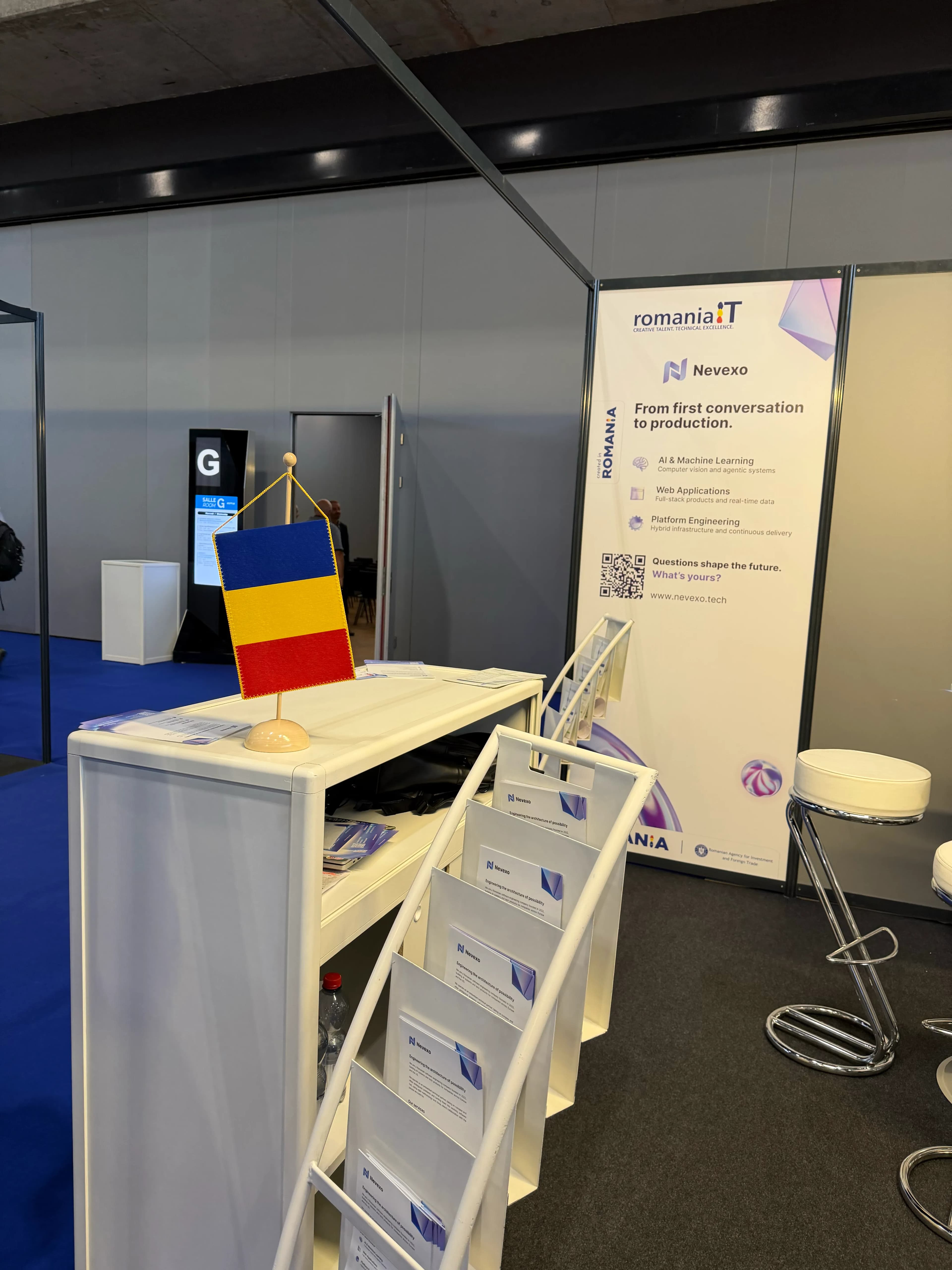
The request we heard most often at our stand in Geneva was for AI agents that work inside a company’s own systems and wait for a person to approve anything important. Below are the conversations behind it and what we’re changing as a result.
From 30 September to 1 October, the Nevexo team ran a stand at Palexpo for Swiss IT Forum(s) 2026, the leading IT event in French-speaking Switzerland. We brought a bowl of sweets and spent both days talking to the people who stopped by.
Geneva was calmer than the conferences we’re used to in Romania. People stayed at the stand longer and were more open about what wasn’t working for them. So this post leaves out the keynotes and sticks to those conversations with companies, engineers and potential partners, and to what we’re doing differently because of them.
The market has moved past chatbots
Almost every conversation turned to AI integration at some point, and the requests were more specific than we expected.
From chat windows to agentic workflows
Hardly anyone asked us for a chatbot. Companies wanted agentic workflows wired into their internal systems: multi-step processes that run on the company’s own data and tools, rather than a chat window sitting off to the side.
A person signs off on what matters
The most tech-savvy companies set the strictest conditions. None of them wanted an agent acting alone. They asked for a human approval step at the critical points, and for granular permissions that spell out what the agent can read, what it can change and what has to wait for a person.
For anyone building agents, the specification that matters most is what the agent is allowed to do and who reviews the result.
AI where it pays off
Companies brought us a wide range of problems, and the hype had turned a lot of them into AI projects before anyone looked closely. A model added to a process nobody has examined rarely makes that process better.
Part of our job is talking clients down from the hype. Sometimes AI is the right tool. Sometimes ordinary software does the job better, and sometimes the process has to be fixed before any tool will help. We tell clients which case they’re in, even when the answer is that they don’t need AI at all.
What we might build next
Two needs came up often enough that we left Geneva impatient to start on them.
The first is AI for the public sector. We see room for services that help people with everyday paperwork, like working out what a law actually says or drafting a contract. Almost everyone has struggled with one of these, so a well-built tool proves its worth the first time someone uses it.
The second is less glamorous and just as urgent: simple, solid ERPs for SMEs. Small and mid-sized companies need a system that covers how the business runs day to day, without the weight of platforms built for much larger enterprises.
Problems we’ve already solved
Many of the problems we heard about in Geneva are ones we’ve already solved for clients in Romania.
That made the conversations more concrete. Instead of pitching from a slide, we could talk through projects we’ve already delivered, built by the same team that would work on the next one.
The sweets got people to stop at the stand. Once they did, most were surprised by how much a team our size has delivered.
What they liked most was direct access to engineers. You talk to the people who build the software, with no layers of management passing messages back and forth.
Project managers, QA engineers and developers all stopped by, and with each of them the conversation got to specifics within a few minutes. That technical depth is what people remembered.
Conversations worth continuing
Some of the best hours of the event went into talks about possible partnerships ranging from networking infrastructure to AWS cloud implementations and some even hardware related.
We also didn’t expect to talk about Romanian traditions in Geneva, but it happened more than once. Many of the international professionals we met know the country and like it, with some having even lived here and others planning to visit (we really hope you do too, we have a beautiful country).
What We’re Taking Home
The main lesson is to keep things simple. The companies we met are wary of complexity and want clear products that do their job well. That’s where we’re putting our focus.
Two days in the Swiss market made us more pragmatic. Over the next few months, that means:
- Templates for specific niches, so clients start from something proven instead of a blank page.
- Reliability first, because that’s what companies told us they want.
- Solid technical support, from the same engineers who built the system.
For the Partners Who Couldn’t Make It
If you’re struggling to scale a system, here’s what we’d have told you over coffee in Geneva. Start with a solid foundation. We cut whatever adds nothing, extra management layers included, and insist on a clean base from day one, because everything you build later sits on top of it.
And don’t expect a new platform to fix it. New tools rarely solve a scaling problem on their own. What decides it is the technical strategy, the execution, how well the team is trained and how carefully the change is managed.
We’ll be at other events and hope to meet you there. If you’d rather not wait, tell us what you’re working on: an agentic workflow, an ERP that fits how your business runs, or a platform that has to grow without breaking.
You’ll be talking to an engineer from the first reply, and we’re happy to think the problem through with you before anyone writes a line of code.